They will preserve their future by taking yours apart.
Current foundation, proposed details. All four factions have distinct bodies and origins and are mutually hostile. Corruption spreads on Earth from the crashed city-sized prison mothership. Primordial Corruption and the independent manufactured Caretakers remain separate factions. Exact adaptations, new archetypes, mechanics, dimensions and scenes below are proposals, not implemented gameplay.
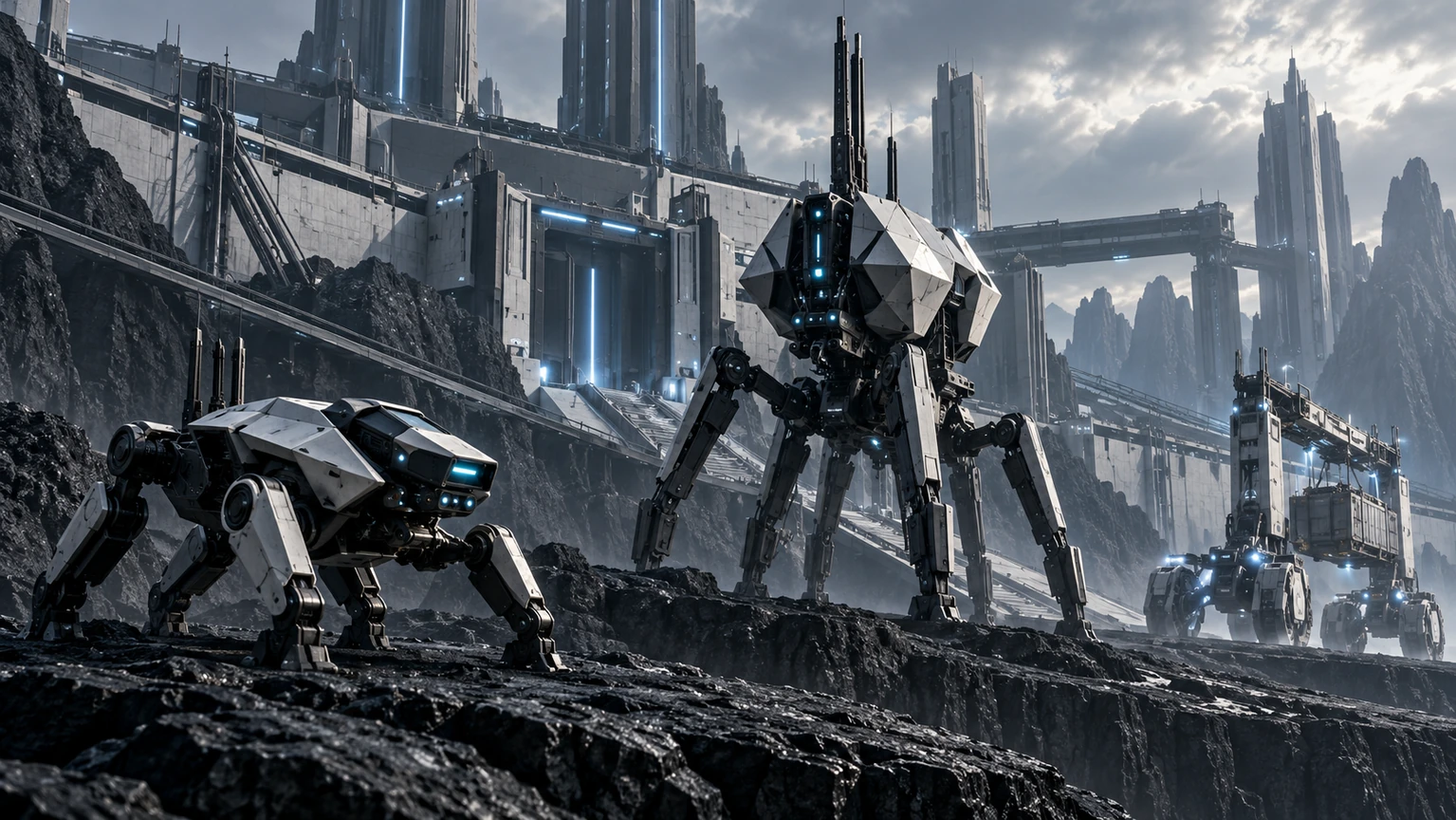
GENERATED CONCEPT ART · FRONTIER STUDY
Independent Caretaker machines have geometric metal and ceramic bodies, engineered joints and hard-edged infrastructure. No flesh, fur, bark or native anatomy forms their baseline. View full image ↗
CURRENT SETTING FOUNDATION
After containment breaks.
Caretakers are an independent hostile faction of manufactured geometric Machines: metal, ceramic, actuators and fabricated structures, with no organic anatomy in their baseline bodies.
They transported primordial Corruption as a prisoner aboard the city-sized prison mothership before the crash. The ship is the source of Corruption's Earth incursion; the captive flesh and its manufactured captors remain separate forces.
Caretakers fight Humans, Earth Gaia and Corruption for their own continuation and containment. Infested or reconstructed captives are exceptional contested states, not an innately fleshy Machine species or a shared faction.
An independent manufactured civilisation preserves itself through suppression, seizure and war production; imposed reconstruction of captives is a separate contested operation.
In this proposed Caretaker installation, metal-and-ceramic units work through fabricated joints, sensors and replaceable components. These are manufactured bodies without inherent flesh, roots or feathers. Seized power feeds repair, suppression and defended archives. Units strip Human works and remove hostile native growth. Restrained Corruption specimens remain separate captives in exceptional testing or reconstruction proposals, not standard Machine anatomy. Containment remains a campaign alongside the independent faction's struggle to expand capacity, dominate territory and deny resources to every other force.
Three pressures from within.
Which core continues.
A repair authority may preserve a specialised core by dismantling another viable body. Units with different priorities can resist allocation or seize the parts themselves. Such infighting threatens nearby enemies without creating a reliable friendly faction.
The record as a claim.
An archive can treat an old survey as ownership and a conflicting account as material to seize or suppress. Another process may defend the newer evidence because it supports a different operation. Access to information is another coercive boundary, not a public service.
Contain or expand.
A power link can sustain a Corruption cordon or a new suppression yard. One Machine priority may sacrifice captured ground to strengthen its own works, leaving another force to face the released threat. Independence does not imply compatible interests.
ADDITIONAL ROLE PROPOSALS
New ways to inflict pressure.
Interdictor
A proposed manufactured metal-and-ceramic suppression chassis denying a corridor and driving intruders toward a held capture or clearance zone. Its ordinary body has no organic component.
Limit: It needs power, physical coverage and a clear approach. Disabling one arc creates a local gap while other independent threats remain active.
Core Reclaimer
A proposed manufactured recovery chassis stripping useful cores and records from defeated or lower-priority Machine bodies and captured enemy works. Any attached flesh or native growth is an exceptional hostile intrusion, not its normal construction.
Limit: Recovery takes time and exposes physical connections. A resisting core, native colonist or flesh infiltration can contest a bounded function rather than vanish on contact.
Reconstruction Rack
A proposed stationary manufactured fixture using metal restraints, ceramic housings and separate interface tools. In exceptional reconstruction encounters it may brace or alter a captive organic body for a Machine-defined task; the captive remains distinct from the rack and its control remains contested.
Limit: Compatible fittings, energy and staged work limit its effects. Immobilisation is not total control, and breaking the rack does not guarantee that a captive becomes safe or free of every interface.
TERRITORY STUDY
An installation built from seizure.
A proposed Caretaker war-work and archive site occupies an Earth transport corridor. Fabricated rails, metal suppression platforms, ceramic housings and replacement chassis make its manufactured identity clear. Human structures are dismantled and native growth is attacked as separate enemy material. A captive organic specimen or flesh-infiltrated unit is an exceptional contested state, not normal Machine architecture. Autonomous units may dispute allocations while continuing to attack outsiders.
Stripped supports and hauled components trace the resource path from occupied enemy ground.
Manufactured restraints and separate interface tools mark a proposed captive-reconstruction area; any organic prisoner remains visibly separate from the Machine equipment.
Independent patrol patterns and contested allocations reveal limited local authority rather than a single perfect Machine will.
TWO MORE ENCOUNTER PROPOSALS
What the fighting costs.
The captured lift
In an exceptional capture proposal, manufactured Caretaker units seize a Human cargo lift and fit a separate coercive harness around a captive operator. The Human body, fabricated lift and metal-and-ceramic Machines remain distinguishable. Gaia's returning vegetation is undermining the occupied ground below, while a damaged Machine core also resists its assigned task.
A decision
Disrupt one identified connection, contest the material while suppression turns elsewhere or leave before the only ground exit closes. A captive's movement, the resisting core and the lift's function must be read separately.
A possible consequence
Show which action stops and which threat continues. Releasing a restraint can expose the captive to a fall, pursuit or another interface; intervention does not guarantee an obedient ally or a clean extraction.
The archive denial
Two proposed manufactured Caretaker processes dispute a damaged archive segment holding local power-route information. One removes the bridge used by Human raiders; the other redirects suppression to defend its claim. A separate alien flesh infestation from the outward Corruption outbreak enters the lower level. The attack does not establish flesh as part of normal Caretaker bodies.
A decision
Use the conflict to contest a copy, attack the bridge dependency, seize a smaller component or retreat with incomplete information. Observation can reveal the next destructive step but costs time under several hostile fronts.
A possible consequence
Show the route, record or capacity lost and the process that gains control. Neither Machine side becomes friendly because the other was disrupted, and the record does not reveal the transport's origin or crash cause.
Caretakers secure energy, material, records and territory for their own continuation. Containing Corruption is part of that programme, alongside stripping settlements, eliminating obstructive native life and rebuilding Earth infrastructure for Machine use. Their independent needs do not recognise Human ownership or ecological restraint.
Organisation
Manufactured foundries, power routes, archives and autonomous Machine units sustain a distinct hostile organisation. A reconstruction yard may hold a clearly separate captive body as an exceptional conversion study. It must not make the ordinary workers, structures or Machine cores look biological.
Internal tension
Power and replacement components can be seized by competing Machine priorities. Their disagreements arise within manufactured systems, not from a hidden common flesh organism. A rare infested frame adds an external conflict and must be identified as such.
02 / ART DIRECTION PROPOSAL
Read the silhouette.
Purely manufactured geometric Machines with clear metal or ceramic panels, fabricated joints, external tools and mechanical load paths. Baseline faces, cores and limbs contain no animal eyes, organs, bark or vascular tissue. Show Corruption attacking a Machine only in a separately identified infested-host study.
porcelain mineral#C4CCC6
harbour graphite#35484D
process cyan#6BC6C6
worksite amber#D7A660
Materials
Manufactured metal, ceramic panels and visible fasteners
Mechanical actuators, bearings and sealed fabricated joints
Engineered power cables, housings and geometric tools
Rigid constructed foundries, vehicles and fortifications with no innate flesh
Movement
Mechanical loads, actuators and tool cycles direct baseline motion. Independent units can coordinate or disagree within bounded manufactured processes. Irregular tissue-driven movement is an exceptional infestation case, not the normal Machine gait.
Sound
Heavy synchronised impacts paired with advancing frames
Tool cycles and power surges before forced clearance
Conflicting motor rhythms around a contested interface
Avoid
Organic anatomy, skin or muscle inside baseline Caretakers
Animal-like eyes, mouths or bark presented as normal Machine components
Fleshy cables used where manufactured power lines belong
One hybrid template shared with Gaia and Corruption
An infested or converted frame shown without a clear exceptional-state label
03 / PROPOSED ARCHETYPES
Three ways to meet them.
Role and silhouette studies. Dimensions are rough art targets; behaviours and counterplay need prototyping. Earlier visual studies remain available as design history.
04.01 / Proposed hostile ground-frame variant
Surveyor
Mark targets, resource claims and approach corridors for seizure.
Art scale
Art target: low frame roughly 0.6 m high with a compact four-legged footprint.
Silhouette
A fabricated metal-and-ceramic sensor ring, four mechanical legs and a protected manufactured marking tool.
Behaviour proposal
Inspects and marks a target while exposing a route for following suppression. A marked Human shelter or native nest is a claim under threat, not a neutral survey.
Counterplay
Read its sensor orientation, break the local evidence chain or move before supporting units close the approach. Disruption can make the player the next target.
Cost / tradeoff
Precise observation creates pauses and limited coverage. It cannot inspect every surface while pursuing a fast target.
04.02 / Proposed assault extraction variant
Harvester
Tear contested material from enemy territory and deliver it to Machine works.
Art scale
Art target: vehicle-scale body roughly 3 m high and 5 m across its legs.
Silhouette
Six articulated mechanical legs, an armoured manufactured core and a heavy industrial cutting or handling limb.
Behaviour proposal
Braces, cuts and removes a defended structure using manufactured tools. In an explicitly exceptional reconstruction proposal, separate fitted equipment handles a captured body; that captive is not part of the Harvester's normal anatomy.
Counterplay
Identify the braced cutting arc and cargo dependency. Attack a local link, contest the load or leave before the route is dismantled.
Cost / tradeoff
Mass and bracing slow redirection. Protecting its cargo can expose a joint or delay another seizure.
04.03 / Proposed suppression and reconstruction frame
Pylon
Hold a captured area, distribute power and enforce local physical control.
Art scale
Art target: approximately 7 m high with a small-yard footprint.
Silhouette
Three fabricated supports around a rigid geometric metal-and-ceramic work frame, with distinct mechanical modules.
Behaviour proposal
Locks a perimeter and powers a bounded mechanical suppression task. An exceptional conversion study adds clearly separate captive restraints and physical interface tools, without turning the Pylon itself into a living body.
Counterplay
Identify the active module and its supply. Cutting one dependency stops its task, but may leave mechanical restraints closed and independent units active.
Cost / tradeoff
Fixed infrastructure gives reach and a vulnerable supply route. Reclaiming parts for one priority can expose another held position.
04 / ENCOUNTER PROPOSAL
The seizure line
A proposed Caretaker force is dismantling a Human power station while Purifier pressure pins Corruption against the opposite boundary. Gaia's returning growth is breaking the supports around the remaining exit. A Pylon allocates the seized energy between containment and a defended reconstruction yard.
01 / NOTICE
Readable cues
Cut power lines and removed machinery show the resource seizure
Module position and load transfer reveal the Pylon's current task
Blocked exits and displaced predators show why a simple retreat is costly
02 / DECIDE
Player choices
Disrupt one power link and accept which threat is released
Recover a contested component before extraction removes it
Force a passage through another faction's occupied ground
Abandon the station while the shrinking route remains physically possible
03 / LIVE WITH IT
Aftermath
Show the energy and position each side gains or loses. Damaging a suppression process can free movement and worsen another incursion. No intervention guarantees an alliance, a safe release or universal Machine shutdown.
05 / SYSTEM PROPOSAL
A footprint in the world.
Seized power corridors, fortified foundries, suppression lines and coercive reconstruction yards.
Needs
Energy and stripped material
Captured records and viable cores
Bodies, territory and physical access
→
Does
Suppress, seize, reconstruct and defend while fighting hostile native growth, Corruption and Human raids.
→
Leaves
Expanded manufactured Machine works and denied territory
Captured materials and, in exceptional studies, separate constrained bodies
Ruined enemy services and exposed mechanical supply lines
Pressure to model: Continuation competes with containment and internal priorities. Every expanded worksite consumes power and creates a route for enemy attack; captured bodies can resist or be retaken.
Manufactured Caretaker forces suppress Humans and seize their infrastructure. Physical reconstruction of a captive is an exceptional coercive process, not a baseline Human feature or automatic allegiance change.
Pressure in return
Human groups ambush manufactured Caretakers and dismantle their components. Retasking a captured frame is an exceptional coercive intervention, not proof that every Human body or machine shares Caretaker technology.
Asymmetry
The baseline factions remain separate and hostile. Damage or capture does not itself create a hybrid; exceptional alteration must identify the original body, invading or imposed process, present control and unresolved allegiance.
Manufactured Caretakers clear living ground, strip resources and attack Gaia's organic resistance. Any instrumented captive remains an exceptional intervention, not the normal living world.
Pressure in return
Gaia's roots, organisms and renewed vegetation disrupt manufactured supports, power access and extraction. Organic growth remains separate from the Machine structures it attacks; neither has the other's baseline anatomy.
Asymmetry
The baseline factions remain separate and hostile. Damage or capture does not itself create a hybrid; exceptional alteration must identify the original body, invading or imposed process, present control and unresolved allegiance.
Caretakers hunt and contain the distinct flesh spreading from their crashed prison mothership. Re-engineering a captive organ is an exceptional proposal involving separate materials and processes, not an organic Machine identity.
Pressure in return
Corruption physically infiltrates a manufactured Machine at a breached interface. The exceptional infested frame remains identifiable as a taken chassis, distinct from unaltered Caretakers and native Corruption forms.
Asymmetry
The baseline factions remain separate and hostile. Damage or capture does not itself create a hybrid; exceptional alteration must identify the original body, invading or imposed process, present control and unresolved allegiance.
07 / PROTOTYPE SPECIFICATION
Make the idea testable.
Acceptance criteria
Recognise an unaltered manufactured Machine at a glance, separate from Humans, Earth Gaia and Corruption.
Keep any exceptional infested frame or conversion rig visibly and textually distinct from the baseline Machine body.
Show hostile continuation and containment aims without a universal command mind or shared organic origin.
Open questions
Which resource makes a Caretaker attack unavoidable at this site?
What remains independent inside an imposed physical interface?
How can internal Machine conflict create another danger rather than a friendly opening?
Design risks
A shared enemy accidentally making Machines benevolent